How Accelerant used data, imagery and AI to respond to Post-Tropical Cyclone Isaias
Written by Constanze Toplansky, Global Head of Exposure Data
Accelerant purposefully avoids Tier 1 catastrophe risks, but any book that includes property coverage will be affected by storms and other natural events. Our ability to predict, prepare, and respond quickly drives better loss outcomes, better customer experiences, and better models.
Post-tropical cyclone Isaias made landfall as a Category 2 hurricane on Friday, October 9th. By Wednesday, October 7th, our Claims team, who monitor every Accelerant Member’s portfolio, had a list of the locations we expected to be affected, the exposed Total Insured Value (TIV), and the relevant policy terms, before the first notice of loss (FNOL) came in. As a service to our active Risk Exchange users, all Members who operate in affected areas were informed automatically. Copies of our moratorium notices were sent to all insurer capital partners.
Hurricane Isaias marked the first time our next generation post-event monitoring infrastructure was put into action. We’ve been building it since the 2025 LA Wildfires, drawing on risk and tech expertise that has been in our DNA since the earliest days of Accelerant.
When one of those events occurs, the question is not whether the exposure exists. It is whether there is a plan to understand it quickly and act on it.
For a Risk Exchange that writes 700+ insurance products and places risk with 90+ Risk Capital Partners, three things matter as soon as a CAT event hits:
- Claims needs an early warning, so it can work with our panel of TPAs to prepare for a higher-than-average claim load.
- Our Risk Capital partners need early severity estimates, so they can reserve accordingly.
- Our Members need early insight into potential claims, so they can support the brokers and insureds who may be affected.
To get there, we brought together three inputs:
- Exposure data with peril-level coverage detail on every risk: for e.g., two locations in the same storm path can have very different claim outcomes depending on whether wind and flood are covered.
- Real-time 3rd-party hurricane and weather data: track the storm path, wind speed and power outages.
- Pre- and post-storm imagery: to make a visual assessment of the damage and identify whether insureds may need help
The work started before landfall. Accelerant Risk Exchange users with a realistic hurricane impact received moratorium notices on new policies. Users without one didn’t. Blanket moratoria are what the industry falls back on when you lack location-level exposure data.
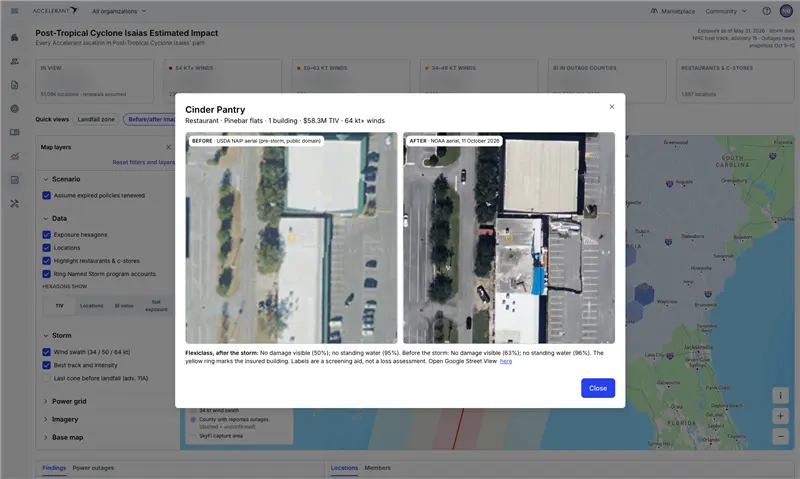
Immediately after landfall, we added before-and-after imagery, location by location. Accelerant’s proprietary insurance-focused image classifier built by Accelerant’s Data Science and AI team, first checks that the pre-storm image matches the insured risk, then compares it with the post-storm image to flag potential damage.
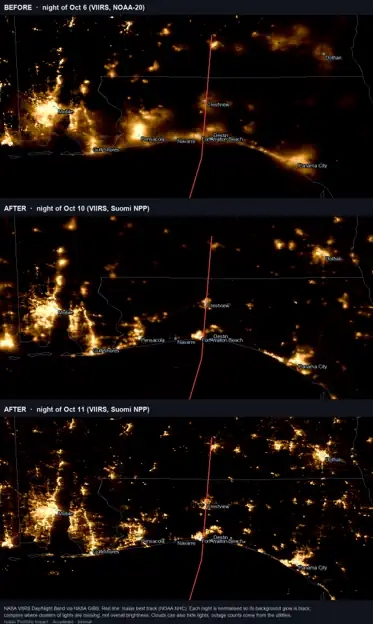
The power grid is where the later, larger losses sit. Night-lights imagery and ground reports show where outages hit. These outages drive business interruption and spoilage losses. A roof-level view doesn’t capture them, and they tend to arrive late and larger than expected.
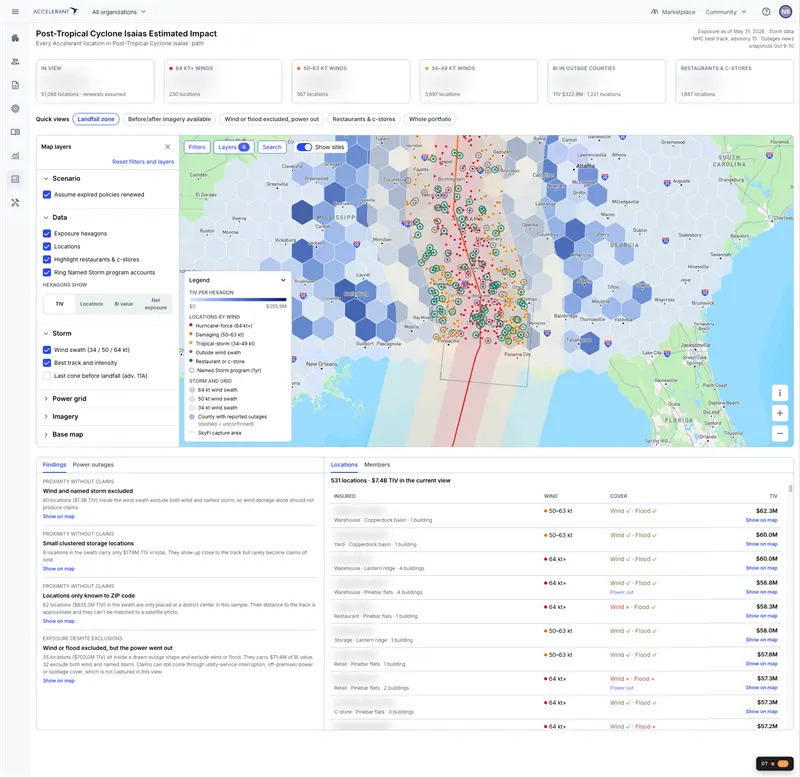
The result is an early read on which locations may have taken losses and where to look first. Claims gets a heads-up before notices arrive. Reserving gets better inputs sooner. These are early indicators, not coverage determinations, and underwriters confirm every location against policy terms.
Loss findings also feed back into Accelerant’s proprietary Weather Risk scores. Each event gives us a chance to test those scores against what actually happened, alongside traditional model output and industry scores, and recalibrate them.
Exposure data, 3rd party data, and our various AI tools are valuable on their own. However together, they create workflows at a speed that weren’t possible before: faster response when an event hits and better decisions for our MGAs and risk capital partners. And because the pipeline is built, every event starts from a stronger base than the last, because the data is richer, the workflow is tested, and the response time shrinks.