A strong MGA with a durable operating model can perform in any market, soft or hard.
What stalls growth in a soft market is usually the operating model underneath it.
Resilient MGAs set proactive strategies that work across market conditions rather than reacting to a soft market. That resilience comes from combining the MGA’s own underwriting expertise with the infrastructure around it: durable capacity, usable data, expert support, and the flexibility to open new paths to growth.
How Soft Markets Stress-Test Businesses
In a soft market, pricing pressure increases and competition intensifies. An operating model built for a hard market is solving for the opposite problem: scarce capacity, restricted appetite, and more demand than the market can easily absorb.
When a hard market softens, MGAs with market-dependent operating models may need to significantly adjust how they grow, price, and deploy capacity. That transition can take time and require the business to play catch up. When conditions change again, the business needs to re-adjust once more.
Repeated reactivity tends to show up in the same places each time conditions shift. Common signs include:
- Growth that depends too heavily on price increases
- Chasing premium to maintain volume
- Limited visibility into portfolio performance
- No visibility below the product level
- Short-term or uncertain capacity
- Limited ability to change course when conditions shift
These don’t just indicate a need for soft market strategy; they are signs that the operating model itself is too dependent on the conditions around it. Breaking that dependency requires a model built to adapt from day one.
Building an Operating Model That Thrives in Any Market
A resilient operating model that functions well in both hard and soft markets combines two core elements:
- Visibility into the data, so MGAs can respond strategically, rather than just react
- Infrastructure that supports product expansion, so MGAs have multiple realistic paths to growth
Visibility into the Data
In a soft market, better data helps an MGA distinguish between where it should compete and where it should remain disciplined. MGAs need to be able to quickly answer questions such as:
- Where is pricing moving?
- Which segments are performing differently?
- Are changes in results being driven by rate, exposure, or portfolio mix?
- Where are claims trends changing?
- Which parts of the portfolio are creating value, and which are deteriorating?
Timely visibility helps MGAs identify leading indicators, such as changes in rate adequacy, business mix, and churn, before those shifts show up in lagging measures like loss performance.
To get that visibility, MGAs need technology that can connect underwriting inputs to outcomes, reconcile premium and claims information, and surface performance at a high level of detail. Without that foundation, important signals can stay buried inside disconnected systems or high-level portfolio views.
That is where the Accelerant Risk Exchange platform can strengthen the operating model. By standardizing and connecting data across the business, it gives Member MGAs a clearer view of what is changing, where performance remains strong, and where action may be needed. The Risk Exchange also gives Members a broader view of exposure, layering geospatial, peril-scoring, and concentration data with insights informed by the wider Accelerant network.
Resilience Through Visibility in Action
Accelerant’s technology helps Members turn detailed portfolio data into more precise underwriting decisions:
- In one poultry portfolio, Accelerant’s Risk Exchange captured risk metadata beyond standard financial fields, including construction and foundation characteristics. By connecting those inputs to premium and claims outcomes, the team could see which risk profiles were performing differently from the broader book and where performance supported holding rate in a soft market.
- Another Member was able to identify declining conversion and retention rates as competitors re-entered the market. Loss-ratio analysis showed the portfolio was still performing favorably, while AI risk scoring helped identify where rate reductions were viable. Together, those insights allowed the team to make targeted pricing changes and respond quickly as market conditions shifted.
With that visibility, Members could access richer risk data, connect it to outcomes, and surface the differences that matter for pricing and appetite decisions.
Infrastructure that Supports Product Expansion
In a reactive model, growth may depend too heavily on maintaining volume in the same products and segments. As conditions soften, that leaves the business with fewer options.
A more resilient model creates multiple paths to growth. MGAs can expand into adjacent products, address new specialty risks, apply existing expertise in new ways, or shift resources toward stronger opportunities.
The challenge is execution. Product expansion only creates value if the MGA can move while the opportunity is still there.
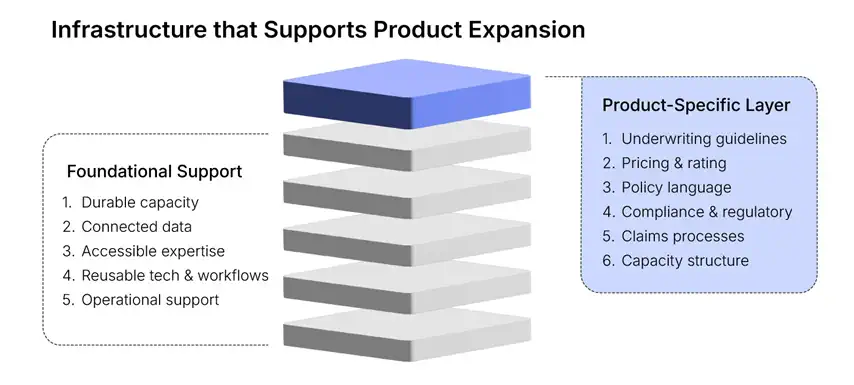
In many cases, the MGA already brings the core ingredients: underwriting expertise, broker relationships, operating capabilities, and relevant historical data. What needs to be built for the new product is the product-specific layer: underwriting guidelines, pricing and rating, policy language, compliance and regulatory requirements, claims processes, and the right capacity structure.
Accelerant supports that work with the infrastructure around it:
- Durable capacity that can support growth beyond a single market phase
- Connected data that can be reconciled across products and systems
- Accessible actuarial, claims, compliance, and operational expertise
- Reusable technology and workflows that can support new products without starting from scratch
- Shared operational support so the MGA does not have to build every capability internally
The platform also reduces the operational work around this support: the platform normalizes spreadsheets, PDFs, and other documents and data feeds, then uses Accelerant Intelligence agents to help resolve data issues so Members can stay focused on product development rather than cleanup. It also supports workflows such as referrals, portfolio segmentation, and ongoing portfolio reviews. When a Member wants to write a risk outside its guidelines, for example, it can submit through the platform, have key details extracted automatically from supporting documents, and connect with an Accelerant underwriter on the next step.
Supported Growth in Action
When Accelerant Members see market changes, they can pivot quickly:
- As pickleball grew within the niche recreational risk market, Accelerant Member Rednil was able to apply its existing specialty expertise to an adjacent category rather than building an entirely new business from scratch.
- As new exposures emerged in the crypto market, Accelerant Member Evertas expanded its offering with a Noise and Sound Liability endorsement for cryptocurrency mining operations.
In both cases, the opportunity came from the MGA’s specialist knowledge; the surrounding infrastructure helped make that opportunity executable.
Build for the Full Cycle, Not the Current Phase
Resilience in specialty insurance is the ability to make good decisions when conditions change, the insight to know where to act, and the infrastructure to move into new opportunities without rebuilding the business each time.
The market will always fluctuate between hard and soft, but a strong operating model gives MGAs room to adapt through the entire cycle. Learn more about how the Accelerant model combines technology, insight, and infrastructure to help MGAs succeed in any market.