While specialty insurance inherently depends on a network of underwriters, capital providers, brokers, data, and expert services, those relationships have not traditionally been fully leveraged. Information and expertise have been siloed, rather than shared.
The real opportunity for specialty insurance lies in building an ecosystem where the network itself becomes a source of value, connecting data, expertise, and decision-making in ways that make every participant stronger over time.
Bilateral Relationships Limit the Value of the Traditional Insurance Model
Specialty insurance typically runs on one-to-one relationships: a broker to an MGA, an MGA to a capacity provider, a capital provider to a specific underwriting program.
The relationships themselves are not the problem; they are fundamental to how specialty insurance works. The limitation is that, in the traditional model, they are often flat and isolated. Information flows from point A to point B, and from point C to point D, but rarely across the broader network. Data and expertise generated within one relationship do not naturally accumulate elsewhere; one MGA’s underwriting experience, for example, does not make the next MGA smarter or more efficient.
The result is a system that underuses the information already within it. Valuable data remains siloed instead of compounding into broader insight, stronger decisions, and a more intelligent network.
The Value of Shared Intelligence
The advantage of an ecosystem does not suddenly appear in a softer market; the market simply makes the difference more visible.
In favorable markets, fragmented relationships can still perform well because strong pricing and profitability mask the limitations of the structure.
When markets soften, MGAs need stronger signals, faster decisions, and more flexibility around how they deploy capacity and expertise. That is where the gap between connected infrastructure and isolated bilateral relationships begins to widen.
Without shared infrastructure, accumulated intelligence, or connected expertise, each participant has less support for spotting changes early and adapting quickly. That is when the limitations of a relationship without connected infrastructure become much more visible.
The ecosystem model works because it benefits everyone involved. Sharing information across the system does not mean handing proprietary data over to competitors; it means aggregating experience into useful intelligence without exposing any individual participant’s information.
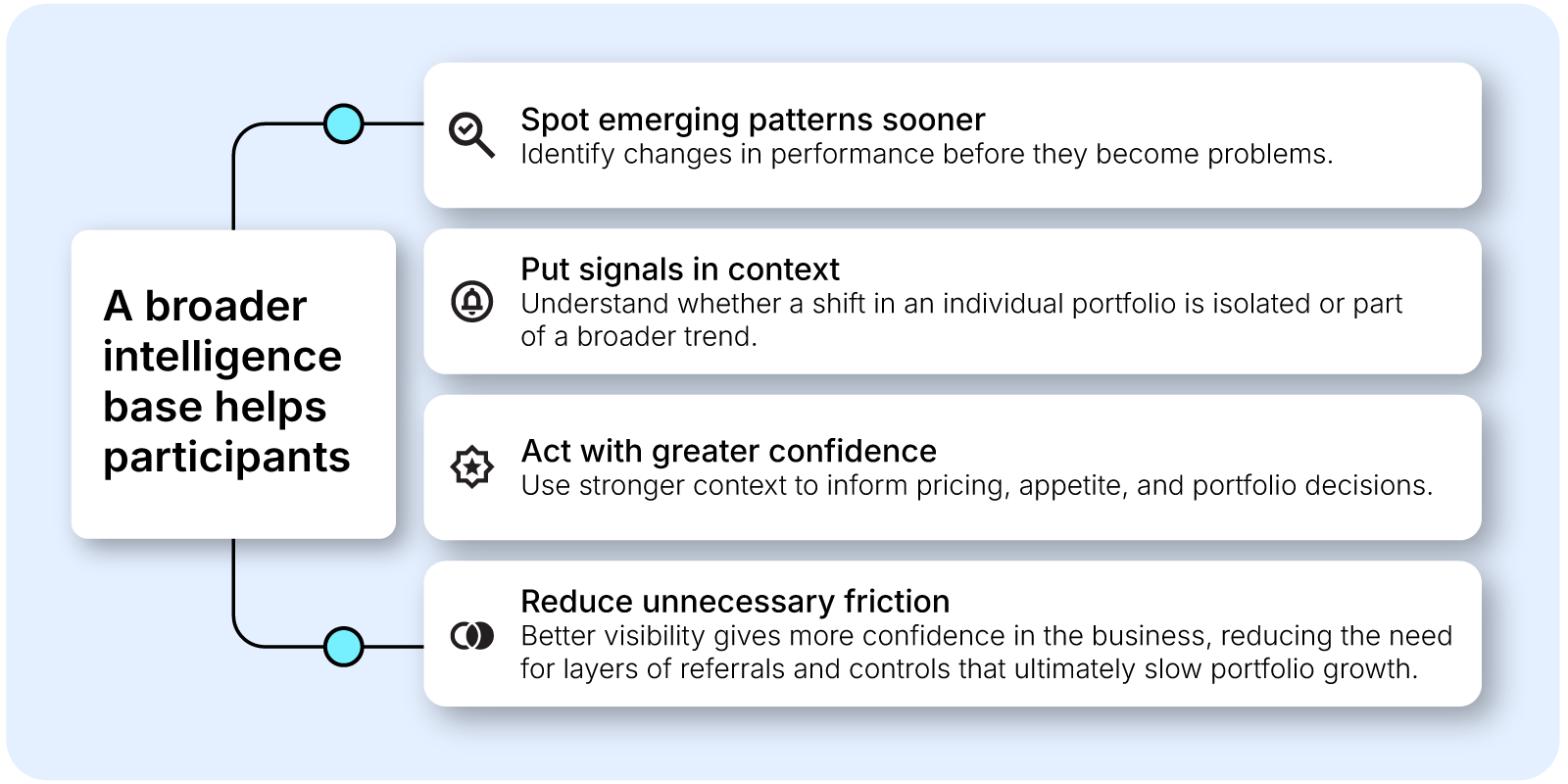
A broader intelligence base helps participants:
- Spot emerging patterns sooner: Identify changes in performance before they become problems.
- Put signals in context: Understand whether a shift in an individual portfolio is isolated or part of a broader trend.
- Act with greater confidence: Use stronger context to inform pricing, appetite, and portfolio decisions.
- Reduce unnecessary friction: Better visibility gives more confidence in the business, reducing the need for layers of referrals and controls that ultimately slow portfolio growth.
Over time, those benefits magnify. As more experience flows through the ecosystem, the system has more information to learn from and more opportunities to turn those insights into better decisions.
How a Network Becomes an Ecosystem
An ecosystem requires more than digitizing the traditional insurance value chain or creating a marketplace that simply connects counterparties. It requires specialized infrastructure that supports shared value: structural alignment, a shared data layer, and compounding advantage.
In practice, that infrastructure should make the machinery around underwriting easier to manage. The goal is to shift effort back toward the work where specialty MGAs create the most value: understanding risks, underwriting them well, and serving distribution partners. Capacity structure, analytics, data processing, and reporting should support that work in the background rather than becoming administrative burdens the MGA has to continually manage.
Accelerant’s Risk Exchange offers one example of what these requirements look like in practice.
Structural Alignment Makes the Ecosystem Durable
For an ecosystem to create shared value, the participants within it need mutually beneficial incentives. If one party benefits at another’s expense, the network may facilitate transactions, but it cannot create the trust or long-term participation needed for value to grow.
Here’s how Accelerant builds structural alignment into its Risk Exchange ecosystem:
- Fair Slice model: Accelerant is designed to succeed when its Members succeed, creating incentives around durable portfolio growth rather than individual transactions.
- Five-year capacity commitment: Longer-term capacity gives MGAs more confidence to invest in people, products, technology, and broker relationships without resetting the relationship every six or twelve months.
Structural alignment also reduces operational friction. Instead of navigating separate teams and approval chains, Members work with a connected cross-functional team. In one case, that structure helped a Member get onboarded and begin trading before its existing capacity provider had finished approving updated underwriting guidelines.
The result is a model designed to reduce friction while keeping the MGA’s own underwriting expertise at the center.
A Shared Data Layer Creates Collective Intelligence
For an ecosystem to learn, information cannot remain trapped inside individual relationships. It needs a shared data layer that can standardize information from across the network, connect underwriting inputs to outcomes, and turn that collective experience into usable intelligence.
Accelerant built that shared data layer directly into the Risk Exchange:
- One governed dataset: Data from 314 Member companies, roughly 700 specialty products, and 22 countries is standardized into a common data model.
- Depth of information: The platform contains more than 180 million rows across 63,000 unique attributes, powering valuable insights that enables market-leading portfolio performance.
Shared infrastructure does not mean treating every specialty business the same way. One Member specializing in pest control had previously seen those risks grouped with conventional contractors; within the Risk Exchange, the program could be evaluated around the niche’s actual liability profile instead.
The value is not just more data but the ability to turn collective experience into better-informed decisions for Members without exposing their proprietary information to one another.
The Ecosystem Compounds Over Time
A true ecosystem becomes more valuable as it is used. Each new participant and data point adds experience to the system, creating a stronger foundation for future decisions.
Here’s how that compounding advantage shows up in the Accelerant Risk Exchange:
- The data layer keeps growing: with a 27% increase in members in the last year alone.
- Intelligence builds on accumulated data: New tools being developed such as Ask AI and others, that depend on the data infrastructure beneath them.
- The advantage takes time to build: Technology can be replicated, but years of accumulated specialty insurance data and experience cannot.
One Accelerant Member saw conversion and retention begin to decline as competitors re-entered the market. Platform analytics surfaced the trend, loss-ratio analysis showed the portfolio was still performing favorably, and Accelerant Intelligence risk scoring helped identify where rate reductions were viable. Because those capabilities were connected, the team could respond quickly and adjust pricing before the trend became a larger problem.
What an Ecosystem Offers That Bilateral Relationships Can’t
The value of an ecosystem ultimately comes down to what it gives participants that isolated relationships cannot.
- Intelligence you can’t build alone. A broader base of data and experience gives MGAs more context for understanding performance, identifying changes, and making decisions.
- Capacity aligned to your success. Long-term alignment gives MGAs more room to invest, adapt, and grow without rebuilding the relationship every few months.
- Infrastructure that compounds with you. As the network gains more experience, the intelligence and support available to participants becomes more valuable.
That broader infrastructure can create resilience when the market softens or circumstances change unexpectedly. A bilateral relationship makes one counterparty a point of vulnerability; an ecosystem provides options beyond that single connection.
The question for specialty underwriters is increasingly bigger than who provides capacity. It is what kind of infrastructure sits behind that capacity and whether that infrastructure becomes more valuable as the business grows.
To see what the Accelerant model could bring to your business, get in touch with our team.