Specialty insurance is built on specialization. But its capacity model is still largely organized one program at a time. But when many specialist risks are assembled into a diversified portfolio, the economics change: volatility can be managed across the whole, capital can be arranged more efficiently, and the market no longer has to rebuild the same chain of relationships program by program.
The opportunity is to preserve what makes specialty insurance valuable while rethinking how risk, capacity, and capital come together at scale.
Specialize Underwriting, But Don’t Fragment Capacity
Specialty insurance rewards focused underwriters with deep expertise in specific classes of risk. MGAs who truly understand the businesses their policies cover can build trust, respond quickly to market changes, and identify opportunities that larger, general-purpose teams may miss.
That specialization is a strength. But it does not follow that every part of the insurance value chain should be organized the same way.
A portfolio-level approach preserves the advantages of specialist underwriting while allowing risk and capital to be considered across a broader whole.
The Traditional Model Perpetuates an Inefficient Cycle
Traditionally, getting specialty risk from the insured to the ultimate source of capital has involved a long chain of participants: retail brokers, wholesale brokers, MGAs, binder brokers or carriers, reinsurance brokers, reinsurers, and ultimately other sources of risk capital.
The issue is not simply that the chain is long; it’s that similar relationships and arrangements often have to be created and managed again at the program level.
Each new program can introduce another set of counterparties, negotiations, data handoffs, and expenses. Every additional step can also create another point where information is delayed, reduced, or disconnected from the parties ultimately taking the risk.
That friction adds up. As Accelerant CEO and co-founder Jeff Radke noted in a recent Tech Talks Daily interview, the industry can spend roughly 40 cents of every premium dollar on expenses and overhead for small commercial businesses.
The cumulative effect is structural inefficiency: many of the same capacity and capital problems are solved repeatedly rather than once across a broader portfolio.
Diversification Changes the Economics
As Jeff put it during the interview, the only free lunch is diversification—the principle most people first meet in an economics class.
That principle is especially important in specialty insurance. A single program may be narrowly focused, concentrated in one class of business, or exposed to a particular geography or set of loss drivers. Viewed on its own, that can make the risk look more volatile or harder for capital to support efficiently.
A diversified portfolio changes that picture.
As of September 2026, Accelerant’s portfolio includes about 700 products across 22 countries and roughly $5 billion in premium, made up largely of relatively small specialty insurance policies. Taken together, those risks create a broader and more balanced view of the underlying exposure.
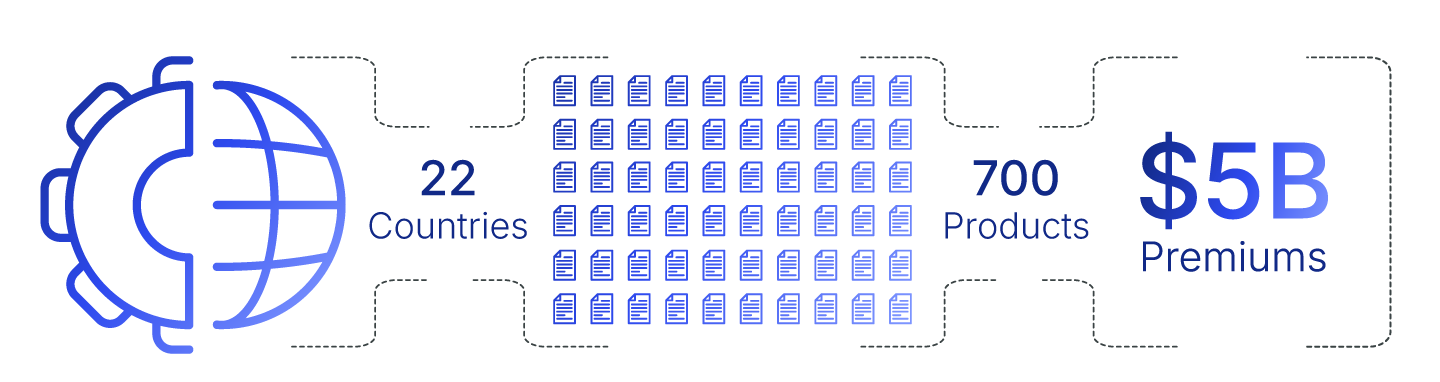
Instead of asking capital providers to evaluate and support each specialist program in isolation, a portfolio-level model gives them access to a wider mix of risks whose performance can offset one another over time.
The result is not less specialization. It is a more efficient way to support specialization with capital.
Turning Diversification Into a Capacity Model
Diversification creates the economic advantage. The next question is how to turn that advantage into a working model for capacity.
That requires more than simply grouping programs together. It requires infrastructure that can connect underwriting teams, carriers, and risk capital providers around the same broader portfolio.
That is the role of the Accelerant Risk Exchange: connecting specialist underwriting with diversified, long-term capacity and the data infrastructure needed to manage it at scale.. By establishing capital relationships across the portfolio, the model gives specialist MGAs a path to capacity without requiring each new opportunity to trigger a fresh capital-sourcing process.
For MGAs, that can make growth easier to support as their businesses expand. For risk capital providers, it creates access to a diversified pool of specialty risk rather than a series of isolated program opportunities.
In practice, the portfolio becomes the framework that allows specialized underwriting and scaled capital to work together more efficiently.
Preempting the Tradeoffs of a Portfolio-Level Model
A portfolio-level model creates clear advantages, but it can also introduce new risks if it is not designed to address them from the outset.
Don’t Treat Risks as Interchangeable
Bringing many specialist programs together creates the potential for important differences between risks to get lost in the aggregate. A successful portfolio model avoids that by giving capital providers access to the detail behind the portfolio.
Accelerant does this through granular, structured risk data. The platform captures, on average, more than 60 exposure characteristics for each policy, allowing capital providers to participate across a diversified portfolio while retaining visibility into the individual risks driving performance.
Build Trust through Transparency and Alignment
Shared infrastructure also creates a greater point of dependency. Concentrating activity through one platform can improve efficiency, but it also increases the need for that platform to operate reliably and transparently.
This tradeoff is similar to market infrastructure such as Nasdaq, as noted by Jeff during his interview. If Nasdaq stopped working, the impact would be significant because so many participants depend on it. But that concentration ultimately works because participants understand how the infrastructure operates and because everyone involved has a strong incentive to keep it functioning reliably.
Accelerant takes a similar approach with its risk capital partners by providing visibility into how the platform operates, including the processes designed to keep data and cash flowing through the Risk Exchange as expected. That transparency allows capital partners to understand the infrastructure they are relying on, how those critical flows are managed, and where accountability sits.
In other words, concentration is not a risk that disappears in a portfolio-level model. It is a tradeoff, but one that can be actively managed through transparent processes and aligned incentives.
A More Scalable Specialty Insurance Model
Portfolio-level specialty insurance is ultimately about matching the structure of capital to the reality of the market. Specialty risk remains highly specialized, but the infrastructure and capital supporting it can operate at greater scale.
That is part of the broader Accelerant model: giving specialist MGAs access to long-term capacity, shared infrastructure, and a wider ecosystem designed to support growth without sacrificing underwriting focus.
The result is a model that preserves what makes specialty insurance work at the program level while creating greater efficiency and resilience at the portfolio level.
Learn more about how Accelerant Risk Exchange brings together specialty underwriting expertise, portfolio-level diversification, and aligned risk capital.